How to Access EnCase Forensic Image File?
Quick Answer
You can access an EnCase forensic image file by opening the .E01 file in forensic software. FTK Imager, Autopsy and EnCase open E01 images directly. A Windows E01 viewer is the quick option when you only need to view data. Keep every segment (E01, E02, E03) in one folder. Select the first .E01 file and the software loads the rest.
Do not rename the file or open it in a text editor. Work on a copy so the evidence stays unchanged.
This guide explains what an E01 file is, which tools open it and how to view its data step by step.
What Is an EnCase Forensic Image File?
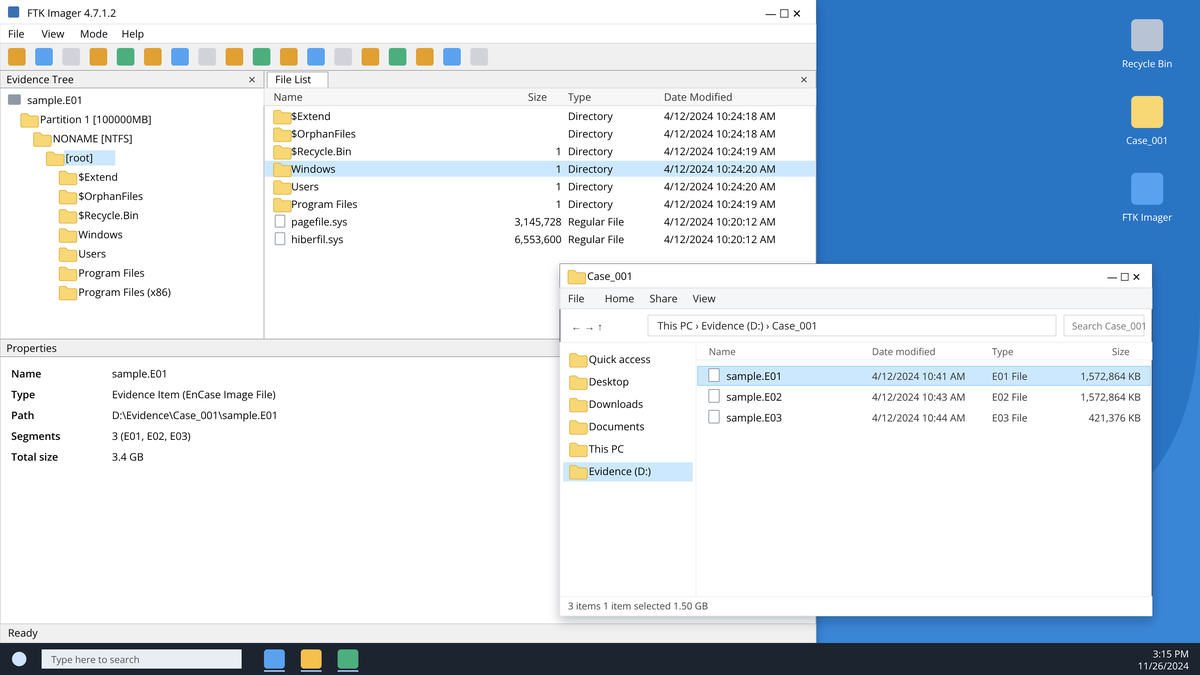
An EnCase forensic image file is an exact copy of a disk, a volume or selected files, saved in the EnCase Evidence File format. The file extension is .E01. The format is also called Expert Witness Format (EWF). The National Archives PRONOM entry notes that Expert Witness was the original name of EnCase, which is why both names refer to the same format.
Investigators use E01 files because they keep the copy and its details together. FileInfo describes an E01 file as an exact copy of the content of a disk. The image stores hash values and checksums for blocks of data. It also stores case details such as the case number, the evidence number, a description and the examiner name, which the examiner enters while creating the image.
An E01 file is a container. It is not a document you open with a double click. Windows has no built-in application for it, so you need forensic software or an E01 viewer.
What Is Inside an E01 File?
An E01 image can hold more than the files you see in Windows Explorer. The table lists what a typical image contains.
| Part of the Image | What It Contains |
|---|---|
| Disk or volume data | Every sector of the source, including deleted files and unused space |
| Case information | Case number, evidence number, description, examiner and notes |
| Hash values | An MD5 or SHA value used to check that the copy is unchanged |
| Block checksums | A check value for each block of data in the image |
| Compression | Optional compression that reduces the image size |
The specification of the format, kept at Forensics Wiki, says a single image can be stored in one or more segment files. The segments are named E01, E02, E03 and so on. The libewf documentation states that EnCase allows a segment file of up to 2000 MiB. The examiner chooses the segment size while creating the image. FTK Imager calls this setting Image Fragment Size, and a value of 0 creates one single file.
EnCase 7 introduced a newer format. The Ex01 extension belongs to that version and supports encryption. The L01 and Lx01 extensions store a logical selection of files instead of a full disk. The steps below apply to .E01 files. A password-protected Ex01 image needs its password before any tool opens it.
How to Access an EnCase Forensic Image File?
Choose the method by what you need. Examiners who analyze evidence use the full forensic tools. Users who only need to view files and emails can use a viewer.
| Method | Platform | Best For |
|---|---|---|
| FTK Imager | Windows | Previewing files and mounting the image read-only |
| Autopsy | Windows, Linux, macOS | Analyzing evidence and building a case |
| EnCase Forensic | Windows | Full examination of evidence |
| ewfmount (libewf) | Linux | Mounting an E01 image as a raw image |
| E01 viewer | Windows | Viewing files and emails without forensic software |
Open an E01 Image in FTK Imager
FTK Imager previews the content of a forensic image without changing it. Follow these steps.
- Open FTK Imager.
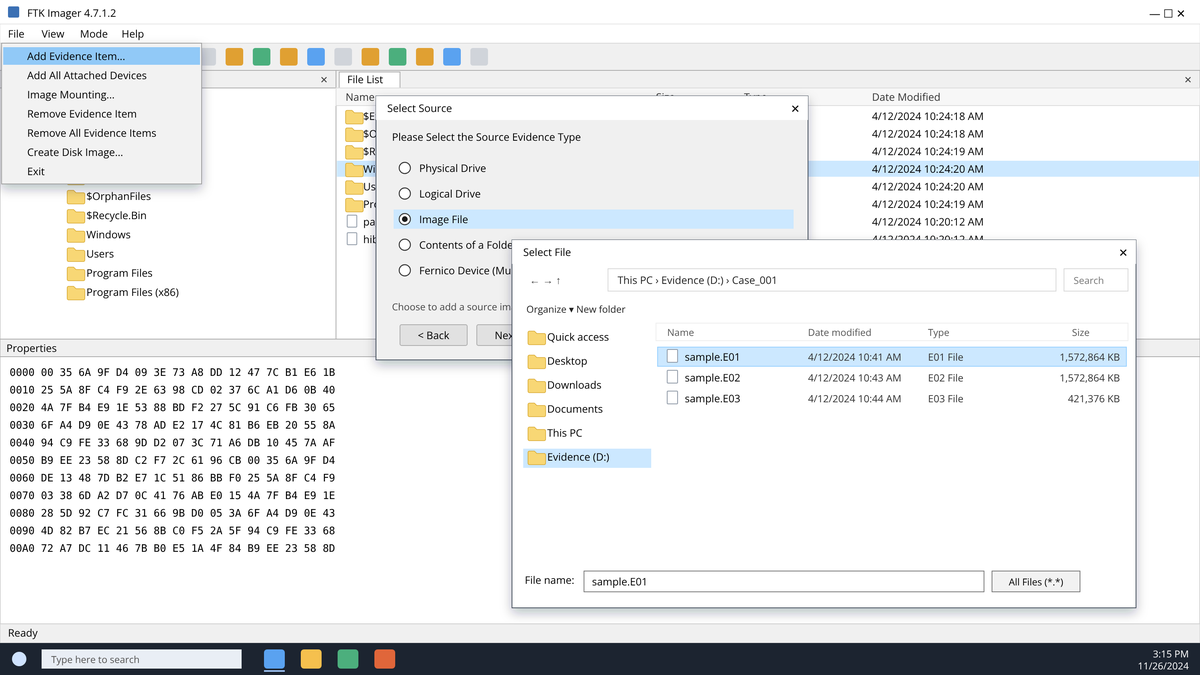
- Click File and select Add Evidence Item.
- Select Image File and click Next.
- Browse to the first .E01 file and click Finish.
- Expand the evidence tree to see the partitions and folders.
To see the image as a drive in Windows Explorer, click File and select Image Mounting. Browse to the E01 file and click Mount. FTK Imager mounts the image for a read-only view. The FTK Imager User Guide describes this feature.
Open an E01 Image in Autopsy
The Autopsy documentation lists EnCase (.e01) as a supported disk image type. Create a case, choose Disk Image or VM File* as the data source type and browse to the E01 file. Autopsy then adds the image to the case and runs the ingest modules you select.
Open an E01 Image in EnCase Forensic
EnCase opens its own format. Open a case, select Add Evidence and choose the E01 file from its folder. EnCase checks the image while it loads. A Forensic Focus thread describes dragging an .E01 file onto the case tree as another way to add it.
Mount an E01 Image on Linux
Linux users can mount an E01 image with ewfmount from the libewf project. The SANS blog on mounting evidence images explains the two-stage process. The first stage exposes the E01 as a raw image. The second stage mounts that raw image with the mount command in read-only mode.
How to View E01 Data Without Forensic Software?
A Windows E01 viewer opens the image without EnCase installed. Download E01 Viewer and follow these steps.
- Install the software and open it. Run it as Administrator on Windows 7 to 11.
- Click Open and select the scan options.
- Browse to the .E01 file and click Open.
- Wait for the scan to finish.
- Select a file in the list to see its name, location, size and creation date.
The viewer supports a search by keyword and by date range. A folder of several E01 files can be added and scanned in one pass. The software runs on Windows only. It does not run on macOS.
Heads Up: A viewer shows files and emails. It does not replace a forensic tool for court work, because hash verification and logging need EnCase, FTK or Autopsy.
Why Does an E01 File Not Open?
Most failures come from a few causes.
- Missing segments. If E02 or E03 is absent, the image is incomplete. Copy all segments into one folder.
- Renamed file. A changed extension stops forensic tools from recognizing the format. Keep the original name.
- Wrong tool. A tool that supports only raw images cannot read E01. Use software from the table above.
- Password. An encrypted Ex01 image asks for the password first.
- Damaged image. A copy interrupted during transfer can fail the hash check. Copy the image again from the original source.
How to Keep the Evidence Unchanged While Opening the Image?
Open the image in a mode that does not write to it. FTK Imager and EnCase treat the image as read-only evidence. Copy the file first and open the copy. Compare the hash value stored in the image with the hash the tool calculates. A mismatch means the image changed after acquisition.
For a wider view of image formats, read the guide to disk image files and their benefits. To work with other formats, see how to mount a disk image file in Windows and how to mount a dd image file. After you open the image, you can extract data from the disk image file or recover deleted files from the disk image. The structure and the role of the format are covered in E01 file forensics, and the image analysis in digital forensics guide explains the next stage.
Conclusion
An EnCase forensic image file is an E01 container that stores a disk copy, its hash values and the case details. FTK Imager, Autopsy and EnCase open it directly, and ewfmount handles Linux. A Windows E01 viewer is enough when you only need to view files and emails. Keep all segments together, never rename the file and open a copy so the evidence stays unchanged.
FAQs
What Is an EnCase Forensic Image File?
It is an exact copy of a disk, volume or selected files in the EnCase Evidence File format. The extension is .E01. The image stores hash values and case details with the data.
Which Software Opens an E01 File?
FTK Imager, Autopsy and EnCase Forensic open E01 files. Linux users mount them with ewfmount. A Windows E01 viewer opens them without forensic software.
Can I Open an E01 File Without EnCase?
Yes. FTK Imager and Autopsy open E01 images without EnCase. An E01 viewer also works when you only need to view the data.
What Is the Difference Between E01 and Ex01?
E01 is the original EnCase image format. Ex01 came with EnCase 7 and supports encryption. Not every older tool opens Ex01 files.
Why Does an E01 Image Have Several Files?
The examiner sets a segment size while creating the image. A large disk then splits into E01, E02, E03 and so on. Open the first segment and the software reads the rest.
Does Opening an E01 File Change the Evidence?
No, when you use a forensic tool in read-only mode. Open a copy of the image to stay safe. Compare the stored hash with the calculated hash to confirm the image is unchanged.
Can an E01 File Be Converted to a Raw Image?
Yes. ewfmount exposes an E01 image as a raw image on Linux. FTK Imager can also export an image to another format.